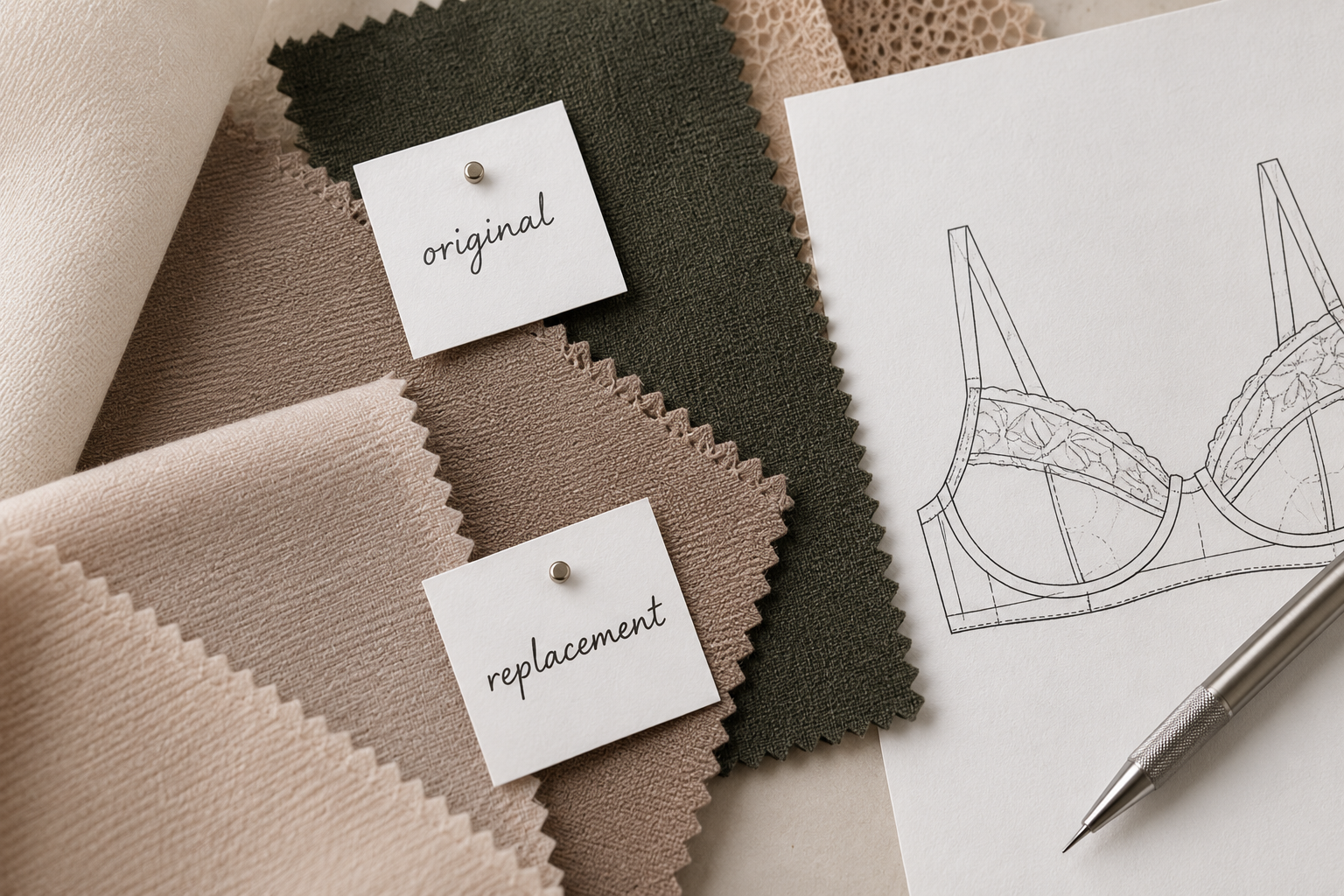
You’ve fitted the product in it, sampled it, tested it, gone through production and, even better, customers like it.
Then the factory tells you the fabric is no longer available... Or the MOQ has increased... Or the price has gone up so much that it no longer works commercially.
Annoying? Absolutely.
Unusual? Not at all.
Fabric substitutions are a very normal part of garment production. Mills discontinue qualities, suppliers change, minimums move and prices fluctuate. At some point, most brands will find themselves needing to replace a material they’d rather keep.
The important thing is recognising that you’re not simply changing a sourcing detail, but instead, you’re changing part of the product.

By the time a product has been developed successfully, the fabric has become part of its DNA. It contributes to the fit, support, recovery, comfort, appearance and how the garment behaves after washing and wear.
So when the original fabric disappears, the goal isn’t just to find something that looks similar, but instead to find something that behaves as similarly as possible.
Two fabrics can have the same fibre composition, look almost identical and even feel very similar when you hold them in your hand, but behave differently once they’re stretched, sewn and worn on the body. A slightly different stretch or recovery can change the fit. A different weight can alter support and drape. A different surface or thickness might change comfort.

The closer you can get to the original fabric,
the less disruption you’re likely to create further down the line.
Credit where it’s due, if your factory tells you the original fabric is unavailable and asks you to approve an alternative, that’s exactly what you want them to do. A substitution shouldn’t quietly appear in bulk production without the brand knowing about it.
The conversation then becomes much more useful: how close can we get to the original, and what difference might this replacement make?
This is where all the work you did creating and maintaining tech packs from the very beginning pays off. Because you know the article number, the composition, the performance characteristics, and ideally, you also kept a cutting of the approved fabric too. (Didn't you!)
That gives you something objective to compare the replacement against. You’re not relying on the factory to track down the original specification or a fabric cutting, or having to work backwards from a garment pulled from stock.
You already know and have evidence of what was approved.
There’s another consideration once the product has already been selling successfully: your repeat customer.
A new customer has no idea what the old fabric felt like. They judge the product in front of them in isolation.
But a loyal customer already knows it. They know how the bra feels when they first put it on. They know how supportive it is and the shape it creates under clothing. They know how the fabric feels against their skin after a full day of wear, how it washes and how it feels after months in their wardrobe.
They're loyal because they love it exactly as it is, and they may not be able to identify exactly what has changed, but they can often tell that something has.
That doesn’t necessarily mean a fabric substitution is automatically a problem. The new fabric might genuinely be just as good. It might even be better!
Different but the same is fine. Different but better is even better. Different and noticeably worse is where there's a problem.
And yes, once you’ve found the closest replacement, you still need to make sure it actually works in the garment before committing to bulk. The closer the fabric is to the original, the less redevelopment you’ll hopefully need. Then once everything is approved, don't forget to update your records.
When a product is working, there’s often a temptation to think of it as finished, but successful products still need managing.
Materials change. Suppliers change. Costs change. Availability changes.
The job becomes protecting the things that made the product successful in the first place, even when one of the core components has to change.
That might mean accepting a fabric that isn’t technically identical to the original. But what matters is understanding where it differs, whether those differences affect the garment and whether the finished product still delivers the fit, comfort and quality your customer expects.

Fabric substitutions happen,
but it’s how you manage them that matters.